
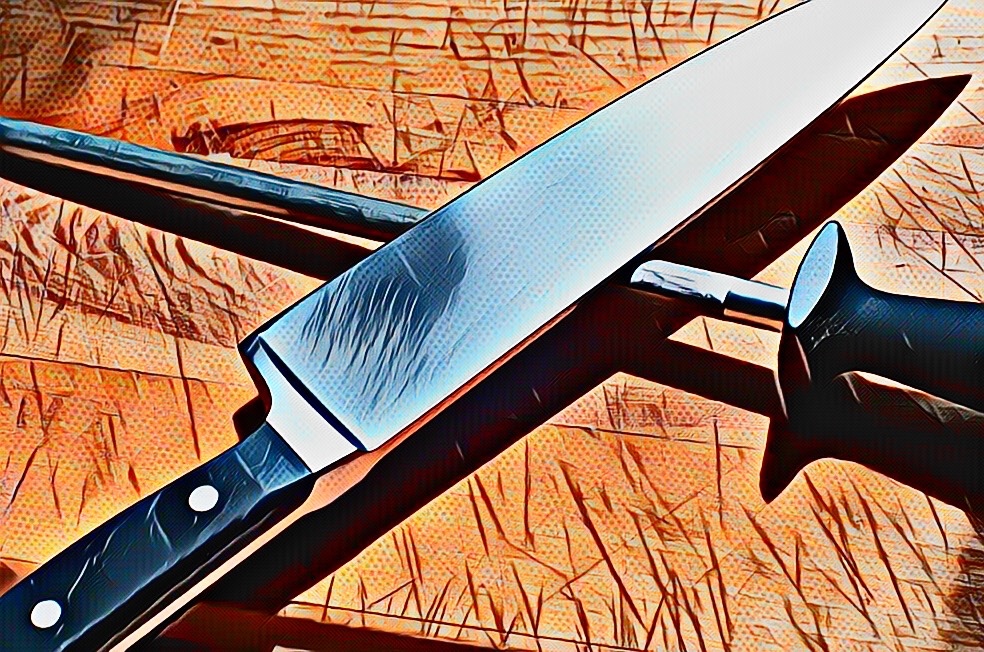
As the name suggests, the go to tool for a chef that needs a knife. Here’s a short guide about this type of blade including,
- What a chefs knife is
- What it’s used for
- What it’s made of
- How to hold it
- Sharpening
What is it?
Thought not my favourite general use blade I find having a large chefs knife (20cm) can be a handy thing to have at times, some go as big as 30cm (good for cakes or pies).
Also known as a cooks knife, this tool was first created mainly for the purpose of disjointing and cutting up large joints of beef, but these days it’s (probably) the most commonly used knife is western kitchens/cooking.
The western version of the chefs/cooks knife comes mainly in 2 forms;
The French style blade; which has a longer flat edge and then curves up to the tip nearer the end of the blade, like walking along a path and having a steep hill halfway along, or,
The German style blade; which is more of one big curve up to the tip of the blade, like walking along a path that is a continuous but not so steep hill.
The most common size I know of is about 18-20cm but they can vary from 14cm all the way up to 36cm, big! The width of the blade tends to be around 3-4 inches at the large end (where the handle is).
The Japanese version of a western chefs/cooks knife is called a gyuto, which apparently literally translates to ‘beef knife’.
A Chinese chefs knife on the other hand is completely different! If you saw one you would probably think that it’s a meat cleaver, though the blades are much thinner.
A santoku knife (possibly my favourite) is also a Japanese style chef/cooks knife. It’s similar in size and appearance, but usually a bit smaller (12-16cm) and blade is completely straight like a ruler (or a cleaver) and has a curve on the top, rather than the sharp edge of the blade. It’s also more lightweight, and tends to be much sharper.
A chefs knife is for general all purpose use, including;
- Slicing
- Dicing
- Mincing
- Vegetables
- Meat
- Fish
- Light butchery, can come in handy for large joints of meat
What are they made of
Most commonly they’ll be made from stainless steel or carbon steel but they also come as ceramic or various other grades or mixtures (laminated), I’ve got a santoku style one that made of molybdenum steel it’s incredibly light and thin.
Generally speaking carbon steel will be easier to sharpen and should stay sharper longer, but can be prone to rusting and staining so watch out how you clean it and store it, they require quite a bit of care if you want it to last.
Good old stainless steel is hardy stuff and will last for years, but comes in many forms, as far as I know there are literally 100s (1000s) of types of stainless steel. The drawbacks are, especially with low grades of stainless steel, that it won’t hold a sharp edge for very long so will need sharpening more often which in turn wares the blade down faster.
High grades of stainless steel (such as the one I mentioned above) can actually work more effectively that carbon steel, but as you’d expect it tends to be more expensive.
Laminated knives are layered layers of different metals, usually a mixture of carbon and stainless steels, trying to make the best use of metals at each part of the knife.
A ceramic blade is quite an interesting thing, they are completely non reactive, which is nice as it will ensure no metaly taste will transfer to the food (I.e. rust) and also they won’t rust or discolour (it’s ceramic). They hold a sharp edge extremely well but the drawback here is that they require specialist equipment for sharpening, which is fine if you have time to go out the way to get it sharpened. Also it is ceramic, so it can get chipped or break if dropped.
How to hold it
Is up to you really, but generally the post effective way to hold it is with your index finger and thumb gripping the base of the blade, with the handle resting in your palm.
Sharpening
Click here to see how to sharpen knives.
 Recipes and Stuff